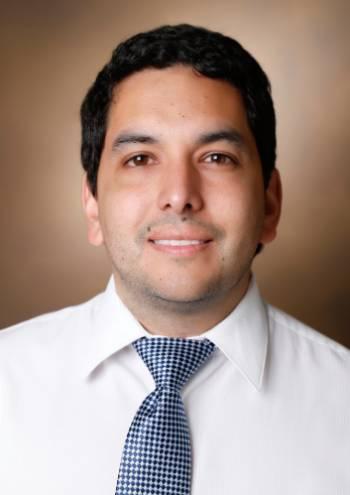
Christian Rosas-Salazar, MD, MPH
What is your current position/role?
I am an Associate Professor of Pediatrics at Vanderbilt University Medical Center. I also direct our Pulmonary Function Testing Laboratory and co-direct the Specialized Program for Asthma Care in Kids (SPARK), a multidisciplinary initiative that provides personalized, evidence-based care to children with severe asthma.
What is your educational background and/or training?
I was born and raised in Lima, Peru, and moved to Mexico after high school to pursue my medical education at the Universidad Autonoma de Guadalajara. I later completed my pediatric residency at the Children’s Hospital of Michigan, followed by a pediatric pulmonary fellowship at the Children’s Hospital of Pittsburgh of UPMC. I also earned a Master of Public Health degree from the University of Pittsburgh.
What is your main area of interest professionally?
Clinically, my primary focus is on improving clinical outcomes for children with severe asthma in our region. This has included developing and expanding our specialized asthma program and establishing evidence-based pathways for the use of biologic therapies in pediatric patients. In the research arena, my research program focuses on what I refer to as “the infectious origins of asthma,” investigating how respiratory viruses and the early-life human microbiome influence immune system development and contribute to the emergence of distinct childhood asthma phenotypes. To explore these complex interactions, we employ a multidisciplinary approach that integrates patient-oriented research with next-generation sequencing, high-throughput immunoassays, advanced bioinformatics, and other cutting-edge technologies. Ultimately, our goal is to uncover mechanisms that can inform strategies for the primary prevention of asthma in children.
How did you become involved in ATS, and what keeps you coming back to the annual ATS International Conference?
I still remember attending my first ATS International Conference as a second-year fellow and being amazed by its scale and energy. It was incredibly inspiring to hear directly from pioneers who had conducted seminal research in pediatric pulmonology, many of whom I had studied during my training.
As a junior faculty member, I began submitting proposals for meet-the-expert sessions, partnering with leading experts in severe childhood asthma. To my excitement, several of these proposals were accepted, and I had the opportunity to co-lead these sessions for 3 consecutive years. These experiences helped me build meaningful connections with colleagues and mentors from around the world. Over time, I became more involved in ATS activities and was honored to be invited to join the ATS Pediatric Program Committee, an incredible opportunity to help shape the conference experience for others. Today, I have the privilege of serving as Chair of that committee, which has been both rewarding and humbling (and a lot of fun!).
What keeps me coming back to the ATS International Conference is the vibrant sense of community, the exchange of cutting-edge science, and the opportunity to mentor and be mentored. No matter where you are in your career, there’s always room to grow, and ATS provides a unique space for that growth. It’s a place where ideas are born, collaborations are forged, and the future of pediatric pulmonary medicine is shaped. Every year, I leave energized, inspired, and reminded of why I chose this path.
Any advice to give students, young clinicians, early career physician scientists or researchers who work in the field of pulmonary disease, critical illness, and sleep disorders?
I often share that I had no prior research experience before starting my fellowship. However, I recognized that the final two years of fellowship would likely be the only time in my career with dedicated, protected time for research. So I made a conscious decision to fully invest in learning research methods during that period, participate in as many research projects as I could, and pursue a Master of Public Health degree. To my surprise, I discovered a true passion for research, which ultimately led me to pursue a career as a physician-scientist.
My advice to those early in their careers is to approach research with an open mind. Choose a mentor who inspires and supports you, because the right mentor is often more important than the right project. Use your fellowship years to absorb as much as you can: learn from experienced researchers, build a strong foundation in scholarly skills, and focus on developing expertise in the disease area that resonates most with you.
You might be surprised by how much you enjoy research, just as I was. While clinical care allows us to make a difference in the lives of individual patients, research gives us the opportunity to impact entire populations. That realization has been one of the most rewarding aspects of my journey.