Kevin C. Wilson, MD, ATSF
Professor of Medicine
Division of Allergy, Pulmonary, Critical Care, and Sleep Medicine
Boston University School of Medicine
Executive Vice-President, Guidelines and Documents
American Thoracic Society

Three statements about you – two true, one false.
I have been to Disney World 17 times.
I was a high school friend of actor and comedian, Will Ferrell.
I won $10,000 by making a half-court shot at half-time during a college basketball game.
Give us your ‘elevator pitch’ biography.
I grew up in Columbia, Maryland where I attended public schools, followed by the University of Maryland at College Park, and then the University of Maryland School of Medicine. Growing up in Maryland was a time filled with family, friends, and happiness.
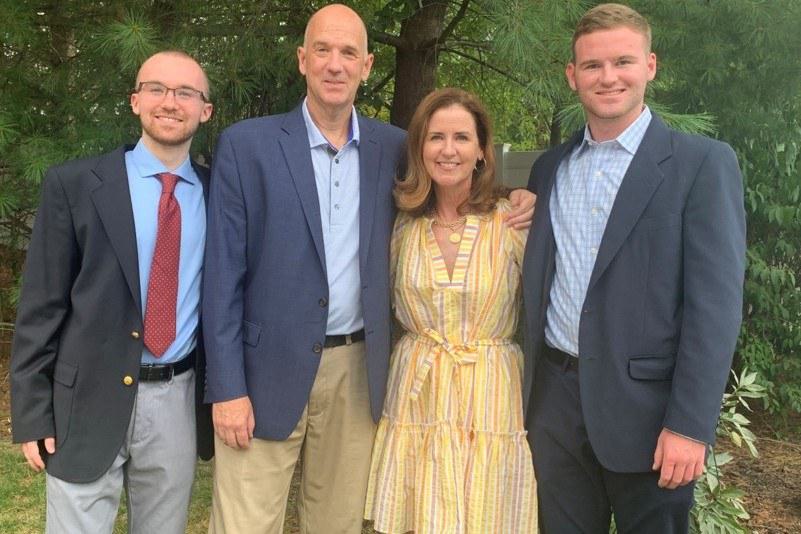
The residency match sent me to Massachusetts General Hospital in Boston. This was followed by pulmonary and critical care fellowship at Boston University. During my training, I met Ann-Marie, a nurse practitioner at the Dana Farber Cancer Institute. We married and chose to raise our family in Westwood, Massachusetts.
I joined the faculty at Boston University after completing fellowship, where I balanced immunology research and clinical care. Our twin sons, Noah and Liam, were born during this time, a life change that prompted me to transition to deputy editor of pulmonary, critical care, and sleep medicine at UpToDate.
My time at UpToDate shaped my future. I learned about evidence-based medicine and became enthralled by the rigorous logic required to translate complex data into life-changing patient care. During this time, I was invited to join the ATS Documents Committee and became increasingly involved in official ATS documents.
I was initially the ATS documents editor in 2010, then left UpToDate and joined the ATS staff in 2012 as chief of guidelines and documents. Since then, my team has increased our document output from three to 20 documents per year, shortened development of documents from 6 ½ years to 1 ½ years, created a pathway for joint ATS/ERS documents, established the guideline methodology training program, initiated the clinical statement, and launched the Global Interstitial Lung Disease Standards, all while maintaining ATS’s reputation as a leading guideline developer known for exploring novel approaches to guideline development.
I have enjoyed my career at ATS. The aspect I enjoy the most is working with thought leaders in both evidence-based medicine and pulmonary and critical care, individuals who I never would have met had it not been for my role at ATS. I appreciate that I have been able to continue providing clinical care at Boston University throughout my career, rising to professor of medicine in 2017.
What would you tell yourself as an Early Career Professional?
I was guided as an early career professional by two prevailing ideas:
- First, don’t be afraid to venture outside traditional career pathways. It took faith to transition from an academic career in clinical care and basic science research to non-traditional careers as an editor for an online medical textbook and as a guideline methodologist for a professional medical society. However, the professional rewards have been great and never would have come to fruition had I been unwilling to venture down a unique path.
- Second, my division chief, David Center, once told me, “Everyone has to do some things they don’t want to do, in order to do things that they want to do.” This advice has served me well. Whenever I feel burdened by various tasks, I remind myself that the burdens are merely inconveniences necessary to remain within the world of evidence-based medicine and guideline development.
If you weren’t in medicine, and were in a different industry altogether, what would you be?
There are two things that I can see myself doing aside from medicine. I would have enjoyed being a constitutional lawyer because I value meticulous writing and persuasive reasoning. I would have also enjoyed being a math teacher and coach, probably at the middle or high school level. I really enjoyed helping my sons with their homework and coaching them on the field; those were good years.
What is your favorite way to spend a day off?
I appreciate the simple things in life. A perfect day is waking up and drinking coffee while watching local news with Ann-Marie. This is followed by walking our dog, Samuel, and then going to the gym and doing lawn work on a beautiful day. The afternoon is spent with my family. A family dinner and baking dessert completes the perfect day.
What areas of medicine are you most excited to see develop?
I look forward to the development of tools that make the practice of evidence-based medicine more efficient, so evidence-based medicine can be readily applied in clinic or at the bedside. Whenever I say this, everyone thinks about using AI to answer clinical questions, but it is much more than that. Clinical decision support tools integrated into electronic health records may someday provide real-time, evidence-based order sets or alerts. It’s about ensuring that the best available science is also the easiest path to take.
What is one advancement in your field you’d like to see in your career?
While my academic focus is on evidence-based medicine, I am also a clinician. I share the frustrations of many ATS members. Prescribing is too complex because different insurances cover different medications and have different prior authorization requirements. Similarly, billing is too complex, documentation is too complex, and so on. I am a firm believer that “the simplest solution is usually the best solution.” Thus, the single advancement that I would love to see before I retire is a dramatic simplification of our healthcare system. I dare to dream.
Which statement (in question #1) was false?
False: I won $10,000 by making a half-court shot at half-time during a college basketball game.
I was selected to take a half-court shot at half-time during a college basketball game, but my shot fell 10 feet short of the basket, and I was booed mercilessly by the sellout crowd.
True: I was a high school friend of actor and comedian Will Ferrell.
My family moved to Irvine, California during my junior year of high school. Will and I were outfielders on the baseball team and quickly became friends. I will forever be indebted to Will for his kindness in befriending me, the new kid in school.
True: I have been to Disney World 17 times.
I love Disney World. I have many happy family memories of Disney trips. I have long said that Disney World is the only place where I can truly relax because everyone knows you are unavailable when you are at Disney World.
Dr. Wilson is both a member of ATS and a member of the ATS staff. He is also a member of the ATS Documents Development and Implementation Committee (DDIC) Committee.