Meet the 2026 Awardees: Hina Agraval, PhD & Rishi Chanderraj, MD, MS

Hina Agraval, PhD, is a Research Associate in the laboratory of Dr. Hong Wei Chu in the Department of Medicine at National Jewish Health in Denver, Colorado. Her research focuses on understanding how environmental exposures such as cigarette smoke and electronic cigarette aerosols alter innate immune responses in the human airway, particularly in the context of chronic lung diseases such as chronic obstructive pulmonary disease (COPD). Her work integrates molecular biology, ex vivo human lung models, and genomic approaches to investigate how metabolic and epigenetic pathways influence antiviral host defense during lung pathologies.
Dr. Agraval earned her M.Sc. in Biotechnology from Gujarat University, where she graduated as a Gold Medalist. She later completed her Ph.D. in Life Sciences at Central University of Gujarat, focusing on the mechanisms of inflammation and airway remodeling in cigarette smoke extract-treated airway epithelial cells. During her doctoral training, she received the prestigious DST-INSPIRE Fellowship from the Government of India, awarded to outstanding early-career researchers.
Her research has produced a strong record of peer-reviewed publications examining the impact of smoking and vaping on lung biology and antiviral immunity. Her work has contributed to understanding how environmental exposures impair host defense against respiratory viruses, including influenza A virus. She has also contributed to studies using advanced human lung models such as precision-cut lung slices and airway organoids. Her review on lung organoids in smoking research was selected as an Editor’s Choice in the journal Biomolecules.
Dr. Agraval has received several recognitions for her research, including the ITSS HESI Immunotoxicology Young Investigator Travel Award from the Society of Toxicology. Her long-term research goal is to uncover the molecular mechanisms and therapeutic targets that can enhance host defense and improve respiratory health in individuals exposed to tobacco products and those living with chronic lung diseases.
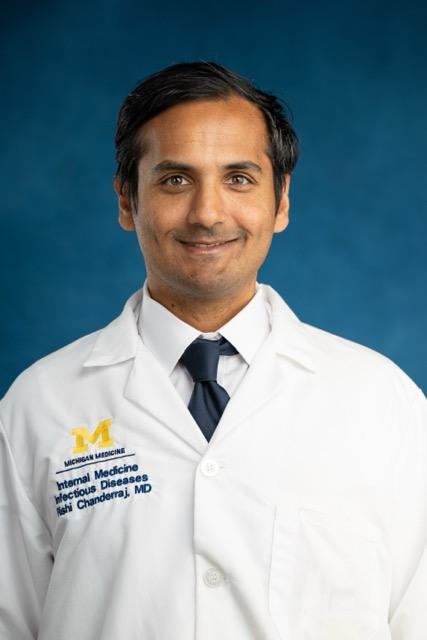
Rishi Chanderraj, MD, MS, is an Infectious Diseases physician-scientist at the VA Ann Arbor Healthcare System and Clinical Assistant Professor of Internal Medicine at the University of Michigan. His research focuses on the causal effects of antibiotic use on clinical outcomes, antimicrobial resistance, and host–microbial interactions in hospitalized patients. He combines quasi-experimental approaches applied to large-scale electronic health record data with prospective microbiologic and translational studies to define how antibiotic-driven disruption of microbial ecology leads to clinically meaningful harm. Dr. Chanderraj’s work has been published in leading journals, including JAMA Internal Medicine, American Journal of Respiratory and Critical Care Medicine, European Respiratory Journal, and Microbiome, with a forthcoming publication in the Journal of Clinical Investigation. His research has advanced understanding of the unintended consequences of anti-anaerobic antibiotic therapy, demonstrating links between microbiome disruption and adverse outcomes such as mortality, acute kidney injury, and infectious complications. He is the recipient of a Department of Veterans Affairs Career Development Award supporting his program on the impact of anti-anaerobic antibiotics on patient outcomes and the microbiome. In addition to his research, Dr. Chanderraj is actively involved in teaching and mentorship across all levels of training and leads quality and safety education within the Infectious Diseases fellowship at the University of Michigan. His work aims to inform precision antimicrobial strategies that account for both pathogen-directed therapy and the broader ecological effects of antibiotics, with the goal of improving outcomes in critically ill patients.
Description
This award is given to a PI-TB member with research contribution(s) in the area(s) of basic science, translational research, and/or "bedside to community" (i.e. implementation) research. Up to two awardees will be chosen for this program. They will showcase their research by each giving a 15-minute talk in one of two sessions featuring “Rising Stars.” Winners of the Rising Stars of Research Program from AII, PI-TB, RCMB, and RSF Assemblies will present their work at the Science and Innovation Center during the ATS International Conference. Certificates will also be awarded during that session.
Criteria
- In-Training, Instructor, Assistant Professor, or equivalent
- Within 10 years of having completed postdoctoral or clinical training, excluding time off for personal circumstances
- PI-TB Assembly Member (primary or secondary)
- Contribution(s) in basic, translational science, and/or “bedside to community” (implementation) research
- Has presented an abstract at ATS within 5 years that demonstrates the nominee’s research interests
- Junior-level nominees may also be considered for a Rising Star Award, based on research.
Submission:
- Nomination letter by sponsor(s) (2-page limit)
- Updated CV or biosketch of candidate